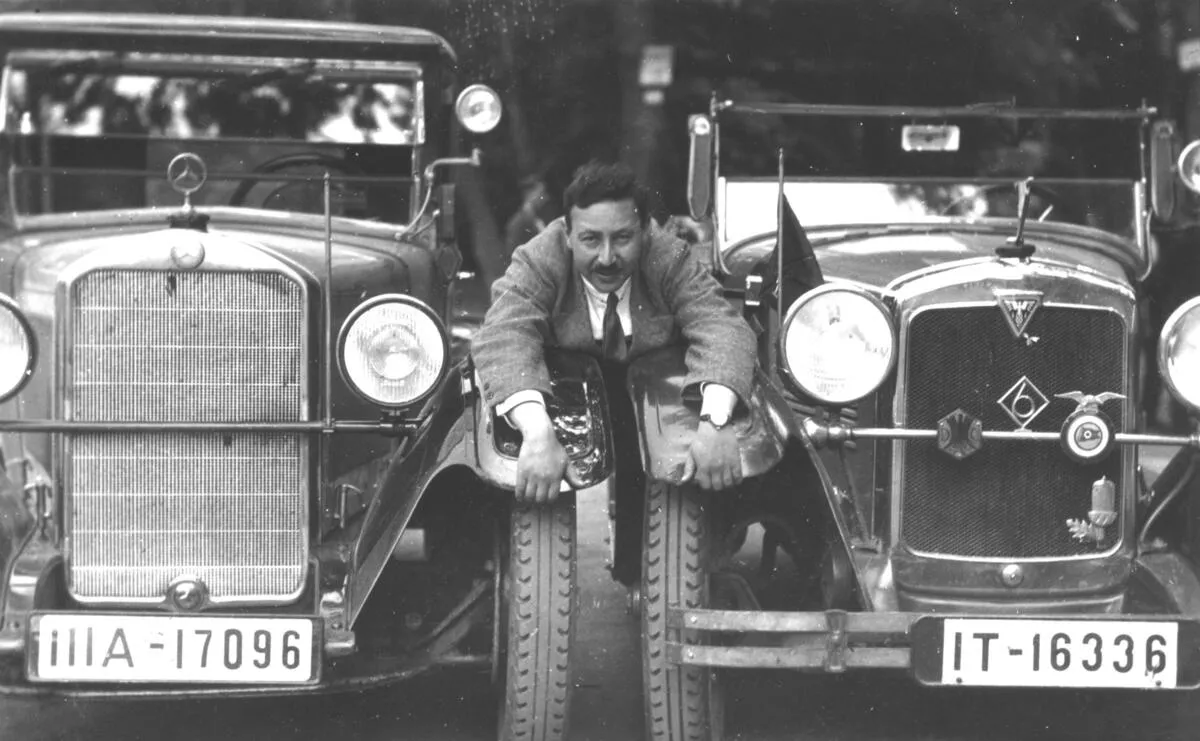
From 1930 to 1933 Josef Ganz, editor of Motor-Kritik and designer of the Maikäfer, worked as a consulting engineer for Daimler-Benz. Letters from the company's directors, now in the Schilperoord archive, show a closer relationship than has long been assumed: Daimler-Benz asked for his advice, used his suggestions on its new small car, refused to let him go in 1931, and ended the cooperation only in 1933 – according to its own lawyer, under pressure from outside.
A consultant the company wanted
According to a sworn statement by a Daimler-Benz representative, Ganz first advised the company in September 1930 on an honorary basis, against a nominal fee he never charged. A paid contract dated 16 December 1930 followed, at 500 Reichsmarks a month from January 1931. The statement gives the reason: Ganz had just become a consultant to Adler, and Daimler-Benz had let him know that an agreement with Adler alone would be regarded as an unfriendly act.
The automotive historian Michael Graf Wolff Metternich named one concrete result of the cooperation: the rear-engined prototype W 17, also called type 120. In October 1931 Daimler-Benz chairman Wilhelm Kissel thanked Ganz for his advice on the creation of a new car – according to Metternich the Mercedes-Benz 170, the company's first car with independent front suspension and a rear swing axle.
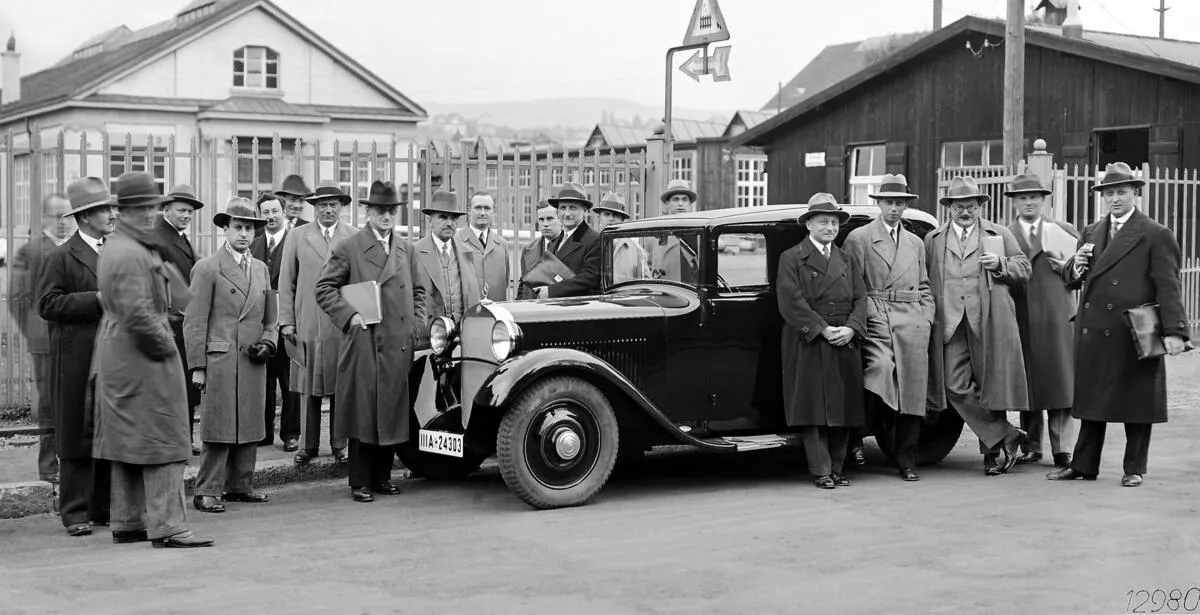
Hans Nibel's letter of June 1931
On 12 June 1931 technical director Hans Nibel wrote to Ganz by hand from a hotel in the Ore Mountains. The letter, deciphered for this page, thanks Ganz for his verdict on "our little car" and continues:
„… die von Ihnen gemachten Vorschläge, die wir, wie Sie wissen, teilweise schon berücksichtigt haben. […] Ich hoffe, daß ich Ihnen bald einen weiteren unserer kleinen Wagen und zwar schon einen der ersten Entwicklungsstücke zur Verfügung stellen kann …“
("… the suggestions you made, which, as you know, we have already partly taken into account. […] I hope that I can soon place at your disposal another of our small cars, and indeed one of the first development examples …")
Nibel also promised to have the constructions Ganz had proposed examined after his return to Untertürkheim. The passage asking Ganz to keep helping to perfect the car is underlined in the original.
Ganz also helped in patent matters. A French engineer, Dimitri Sensaud de Lavaud, held a German patent on four independently sprung wheels that could have stood in the way of the new car. In October 1931 Ganz pointed Nibel to an American patent of 1916 that anticipated it. Daimler-Benz invited Sensaud de Lavaud to Stuttgart, and in February 1932 Nibel told Ganz that the Frenchman had recognised the company’s prior use and handed over his patents in return for his costs.
"We cannot bring ourselves to accept your offer"
Ganz's critical journalism made enemies in the industry. On 8 November 1931 he wrote to the Daimler-Benz board that he had heard the company was being reproached for working with him, and offered to give the contract back. Two days later the board replied:
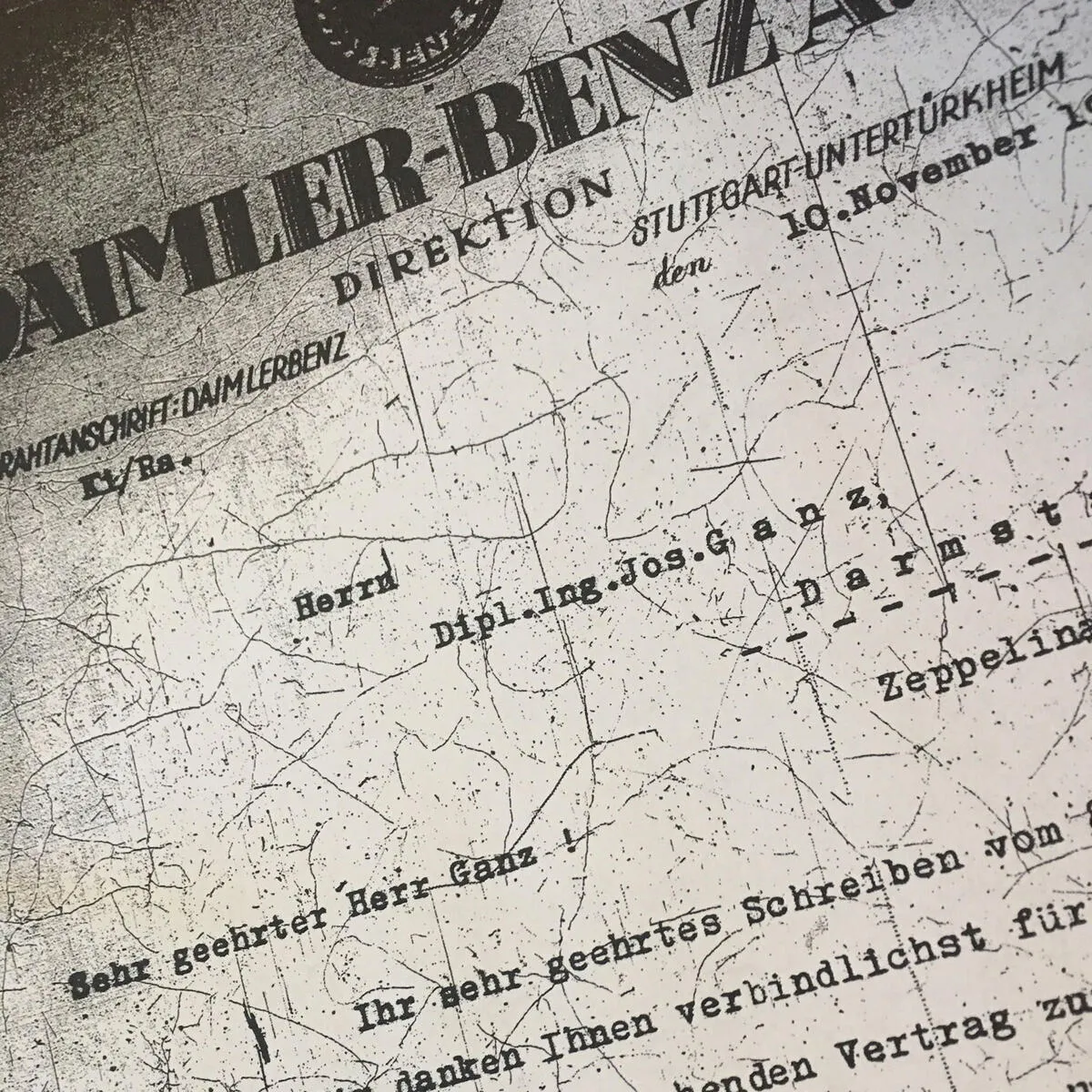
„Ihre vornehme Einstellung kann nur unsere vollste Anerkennung finden. So sehr wir nun auch das Verständnis, das in Ihrer Erklärung zum Ausdruck kommt, würdigen mögen, so können wir uns doch nicht entschliessen, von Ihrem freundlichen Angebot Gebrauch zu machen, bitten Sie vielmehr höflichst, uns auch weiterhin mit Ihrem wertvollen Rat zur Seite zu sein.“
("Your noble attitude deserves our fullest appreciation. However much we value the understanding expressed in your statement, we cannot bring ourselves to accept your kind offer, and instead politely ask you to continue to assist us with your valuable advice.")
Michael Graf Wolff Metternich quoted this letter in 1990 only up to "Anerkennung finden", which can leave the impression that the contract ended in 1931. The full letter shows that the cooperation continued for two more years.
Two contracts – and their sudden end in 1933
Besides the consulting agreement, Ganz had a second contract with Daimler-Benz, dated 20 January 1933 and effective from 1 October 1932, under which he offered the company his future inventions for 250 Reichsmarks a month. According to Paul Schilperoord, Ganz gave important impulses for the Mercedes-Benz 170 and the 120 H, and the new Mercedes-Benz 130 H of 1934 – a rear-engined car with a backbone tube chassis, independent suspension and swing axles – followed the Maikäfer layout.
In October 1933 Jakob Werlin, Hitler's adviser on motor cars, joined the Daimler-Benz board at Hitler's urging. On 29 November 1933 Daimler-Benz terminated both of Ganz's contracts with immediate effect, stating that "the development of circumstances" no longer allowed him to provide his services as agreed. According to Schilperoord the inventions contract could not be ended before 31 December 1935, and Ganz appealed.
In a declaration signed in Vaduz on 7 April 1935, the lawyer Dr. Heinrich Kuntze recorded that a Daimler-Benz lawyer had confirmed in his presence that the termination had not come from the board itself, "sondern infolge eines Druckes von Aussen" – but as a result of pressure from outside.
Daimler-Benz later gave its own account. In a letter of 3 August 1950 to the restitution authorities in Stuttgart, the company wrote that Ganz had wrongly suspected it of denouncing him to the Gestapo – “the opposite was the case”. On 22 January 1935, with Ganz by then living in Switzerland, the two sides reached an agreement; in June 1935 the inventions contract was put back into force, until Ganz’s lawyer terminated it with effect from 31 March 1936. The monthly payments, the company stated, were made until then.
The Mercedes-Benz 130 H and Hitler's sketches
At Christmas 1933 Ganz borrowed a brand-new 130 H from the factory and tested it in the snow of the Black Forest. The car followed the Maikäfer layout, but against his advice the engine sat above and behind the rear axle. In Motor-Kritik he wrote that it was "really not a true rear-engined car", but "rather a car with an outboard motor".
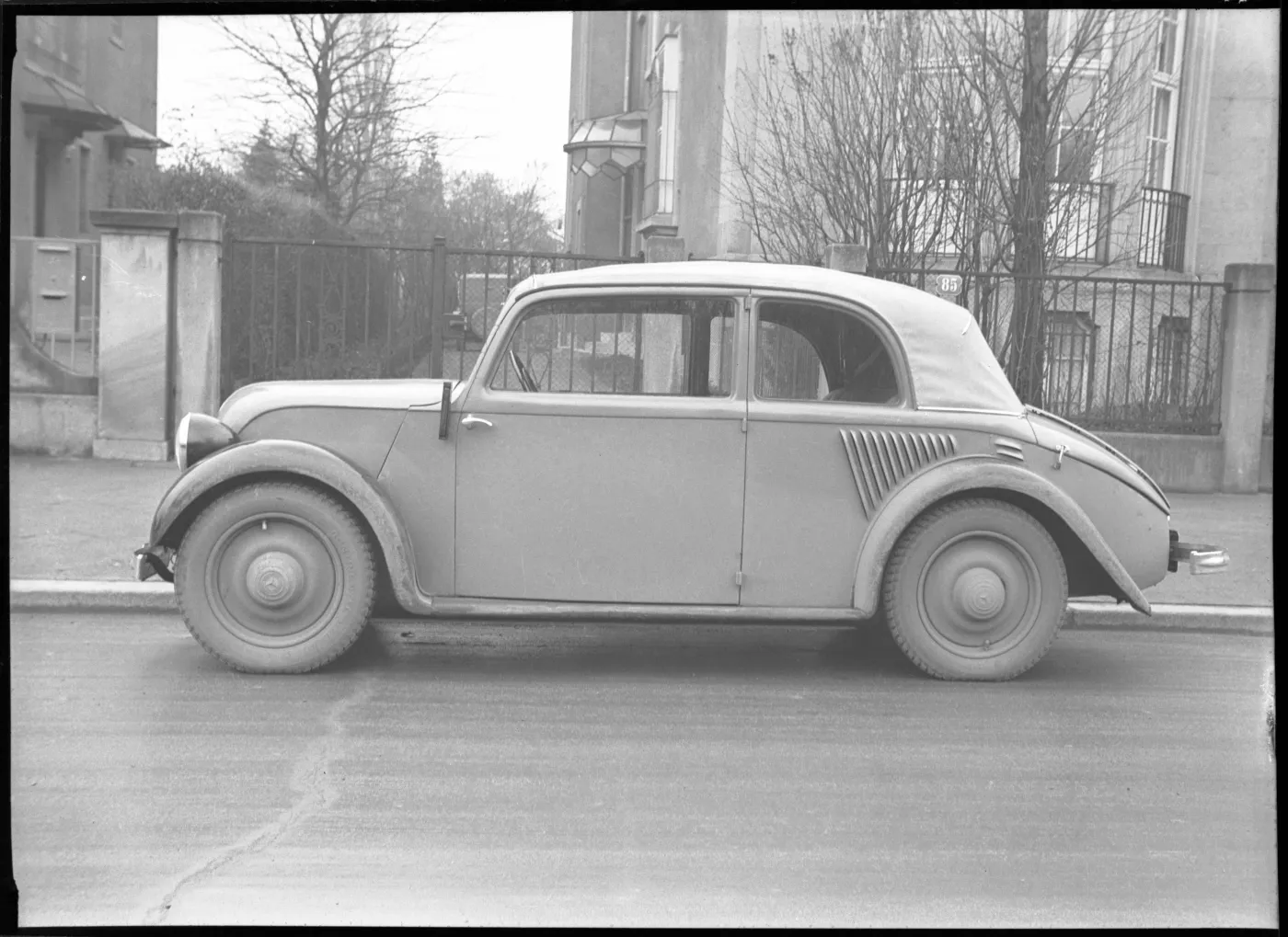
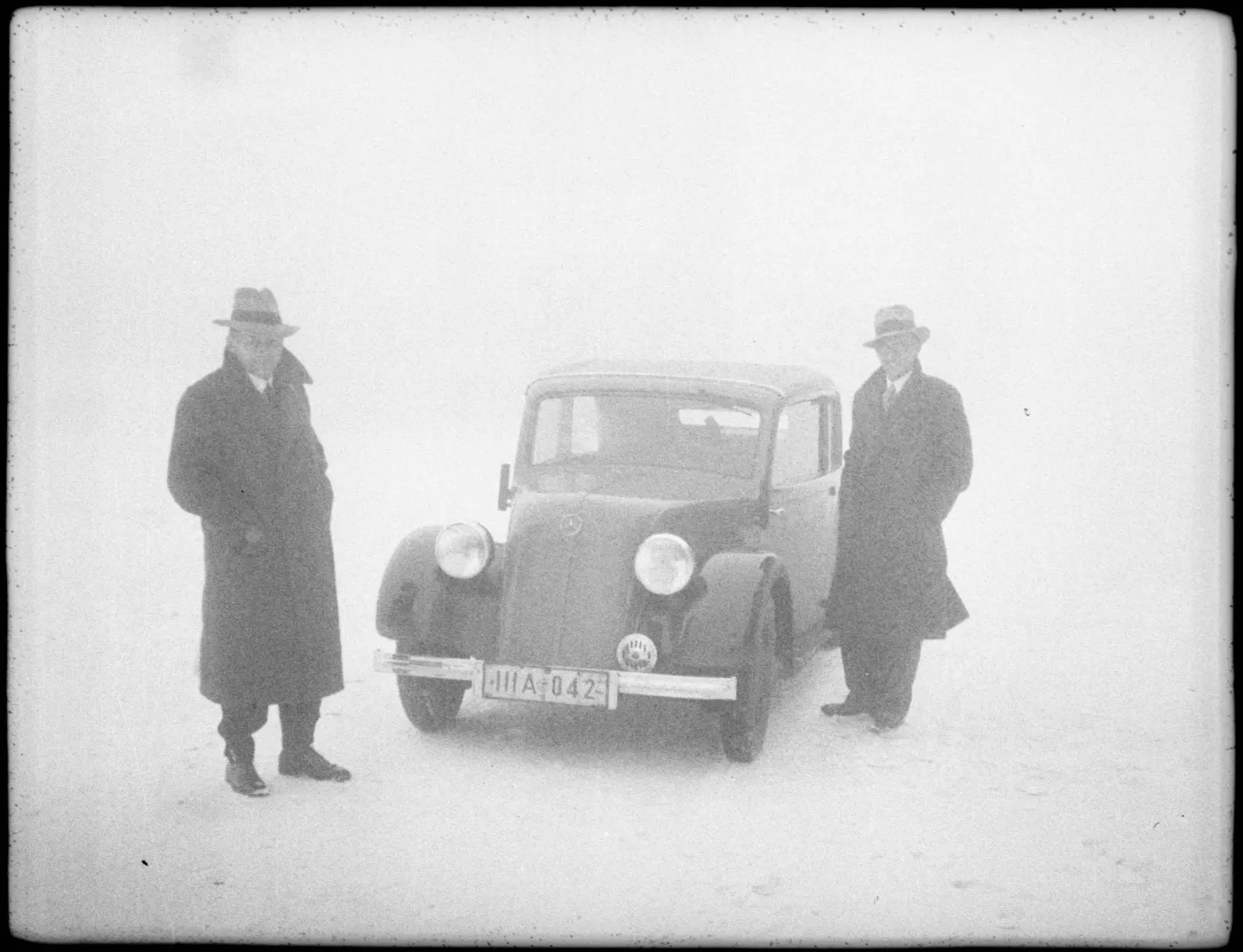
At the Berlin motor show in March 1934 Hitler took a close interest in the 130 H. Both Christof Vieweg and Paul Schilperoord describe the sketches Hitler drew for Ferdinand Porsche shortly afterwards as closely resembling the 130 H. By then Ganz had lost all his German contracts, and later in 1934 he left the country.
A licence on a disputed patent
In 1932 Daimler-Benz had applied for patent DE 642 192, "motor vehicle with four independently sprung wheels", granted in 1937 and used for the rear-engined 130 H and the 170 H. Ganz regarded it as based on his Maikäfer design. His lawyer Fritz Isler test-drove the Maikäfer in 1937 and concluded that it matched the patent claim in every respect. In January 1938 the Swiss company Erfiag, to which Ganz had transferred his rights, demanded the patent and then sued Daimler-Benz in Frankfurt. On 9 August 1938 the two companies settled: Erfiag withdrew the suit and recognised the patent as Daimler-Benz property, and in return received a licence – according to Paul Schilperoord one Swiss franc per vehicle built by Daimler-Benz. After the war Ganz tried again. In his restitution claim of 25 December 1948 he demanded the patent and a licence fee for the 130 H, the 170 H and the Volkswagen, and in a declaration of 24 October 1950 Erfiag stated that it had acted under pressure in 1938. Daimler-Benz rejected this. Metternich took 24 October 1950 for the date of an agreement; the files show it was the date of Erfiag’s declaration. Whether Ganz ever obtained anything from these claims is not known.
Sources
- Letters Daimler-Benz – Josef Ganz, 1931–1933, sworn statement (undated), declaration Dr. H. Kuntze, Vaduz, 7 April 1935. Schilperoord archive, to be made accessible at the Archiv für Zeitgeschichte, ETH Zurich.
- Restitution case Josef Ganz against Daimler-Benz and others, 1948–1951: claim by Ganz, 25 December 1948; letters of Daimler-Benz AG, 3 August 1950 and 2 February 1951. Staatsarchiv Ludwigsburg, FL 300/33, Rest S 4590.
- Paul Schilperoord: Die wahre Geschichte des VW-Käfers. Huber, Frauenfeld 2011, pp. 191–198, 209, 216, 263 (English edition: The Extraordinary Life of Josef Ganz).
- Michael Graf Wolff Metternich: "Der streitbare Geist Josef Ganz". Automobil Revue no. 41, 4 October 1990, p. 71.
- Christof Vieweg: Die Akte Volkswagen. GeraMond, Munich 2014, p. 58.
- Patent DE 642 192, Daimler-Benz AG, priority 22 April 1932.