Ferdinand Porsche (1875–1951) is remembered as the designer of the Volkswagen Beetle. Josef Ganz had campaigned since the late 1920s for a small, affordable car with a rear engine, independent suspension and a streamlined body. The two men never worked together, but their paths crossed three times: at the motorcycle maker Zündapp in 1931, in the race for the state-sponsored Volkswagen in 1933/34, and after the war in the question of who deserved credit for the Beetle. This page sets out what the published sources show.
Year by year
Josef Ganz on the left, Ferdinand Porsche on the right, and in the middle the events that shaped the road to the Volkswagen.
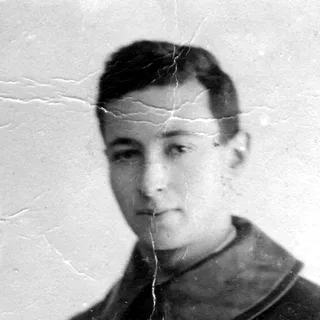
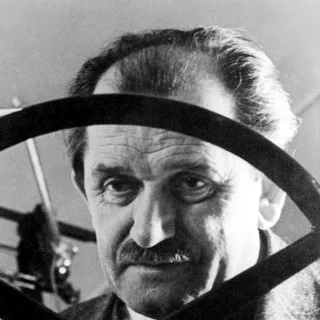
- 1875 Ferdinand Porsche
Born on 3 September in Maffersdorf, Bohemia.
- 1898 Josef Ganz
Born on 1 July in Budapest; grows up in Vienna.
- 1900 Ferdinand Porsche
His electric Lohner-Porsche is shown at the Paris World Exhibition.
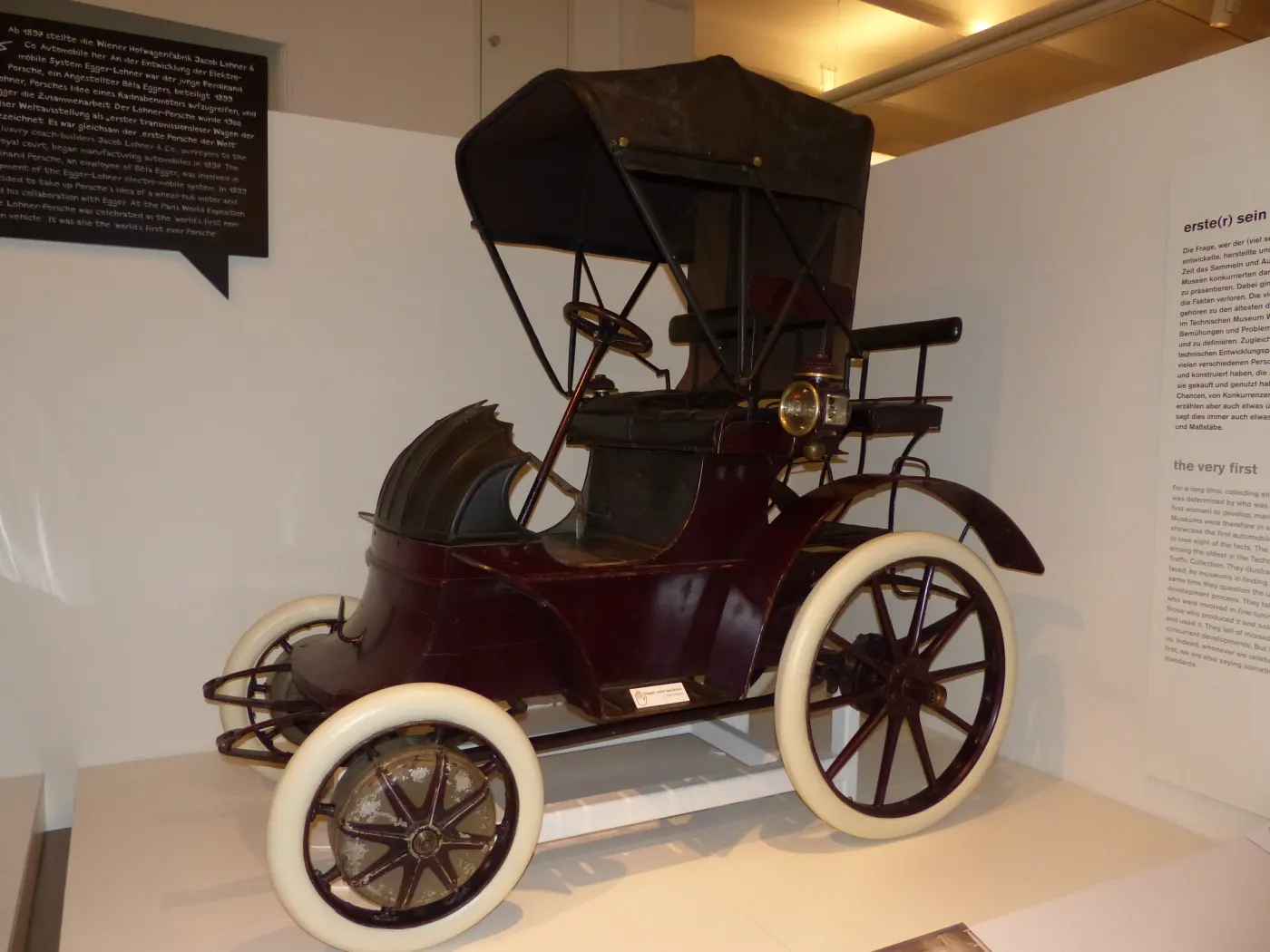
Lohner-Porsche electric phaeton, 1900 (photo Bernd Gross, Wikimedia Commons, CC BY-SA 4.0) - 1906 Ferdinand Porsche
Becomes technical director of Austro-Daimler in Wiener Neustadt.
- 1923 Josef Ganz
First sketches of a small, light car.
Ferdinand PorscheBecomes technical director of Daimler in Stuttgart.
ContextHans Ledwinka’s Tatra 11 goes into production with a backbone tube chassis and swing axles.
- 1927 Josef Ganz
Becomes editor-in-chief of Klein-Motor-Sport, renamed Motor-Kritik in 1929, and campaigns for a light car with central tube, swing axles and rear engine.
Ferdinand PorscheJuneHis supercharged Mercedes-Benz S sports cars win at the opening of the Nürburgring; one of them is driven by Adolf Rosenberger.
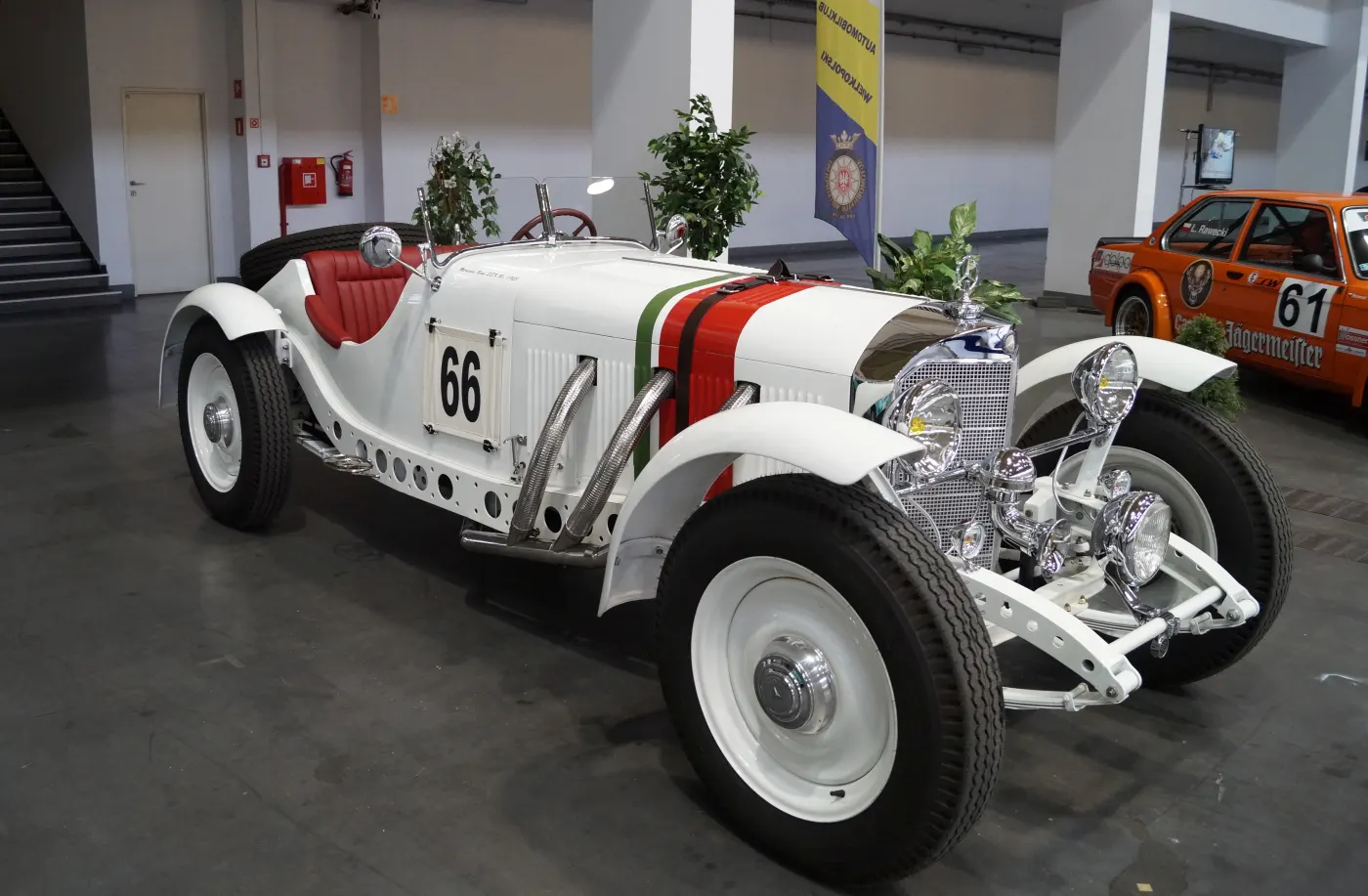
Mercedes-Benz SSK, 1928, developed from the S (photo Jakub Maciejewski, Wikimedia Commons, CC BY-SA 3.0) - 1929 Josef Ganz
German patent application for a chassis with a rear central tube (DE 528 643).
Ferdinand PorscheLeaves Daimler-Benz for Steyr in Austria.
- 1930 Josef Ganz
Discusses a small car with Zündapp’s director Fritz Neumeyer, but builds his prototype at Ardie instead.
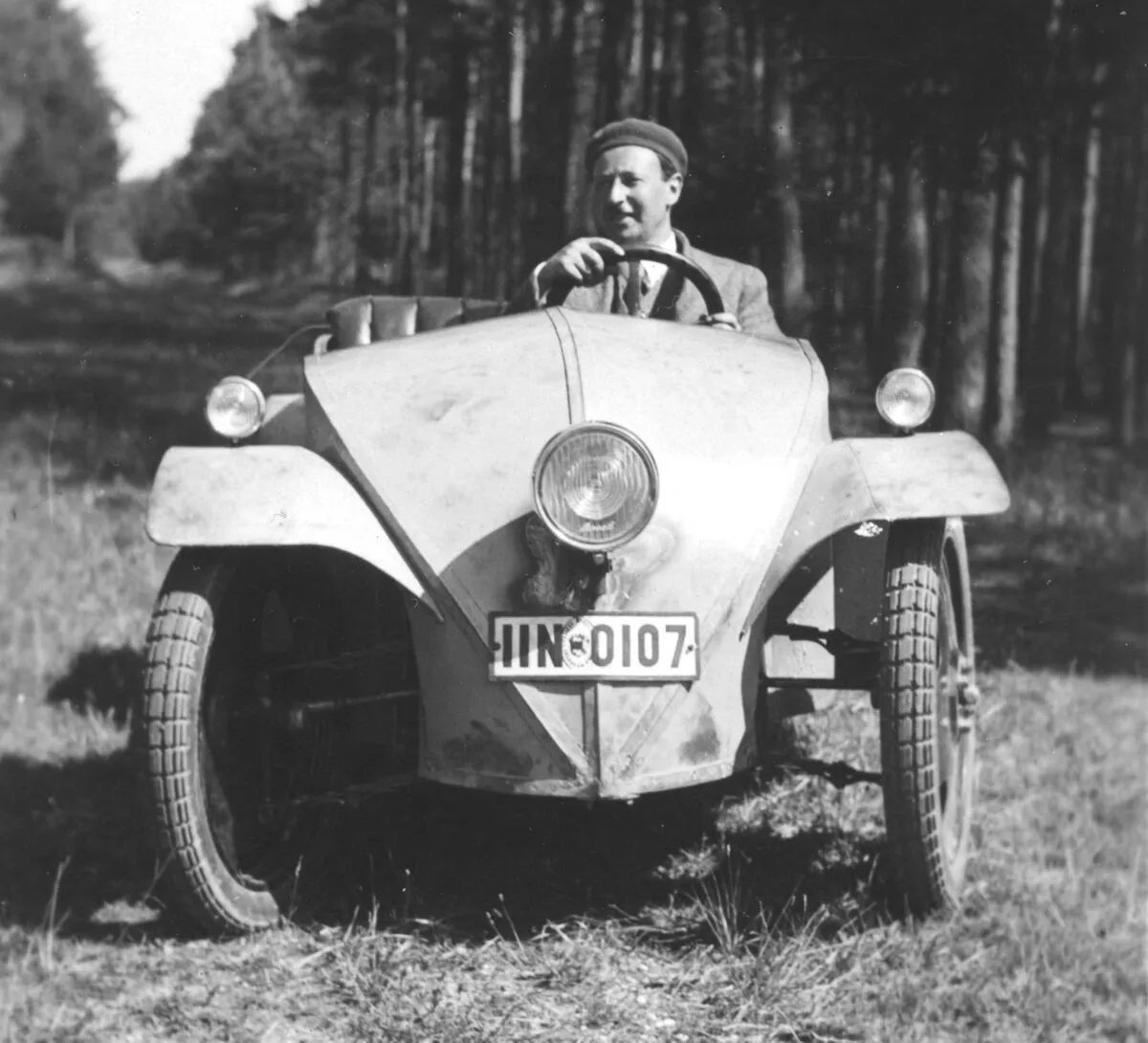
Ardie-Ganz prototype, 1930 - 1931 Josef Ganz
Builds the Maikäfer prototype. Consultant to Daimler-Benz.
OctoberFerry Porsche and Adolf Rosenberger of the Porsche office come to Frankfurt to test-drive the Maikäfer.
NovemberIn Motor-Kritik Ganz writes that he has taken many colleagues from the press and members of “the competition” for drives. The cover of the issue shows the Maikäfer with two men on board; Paul Schilperoord identifies them as Ferry Porsche and Rosenberger.
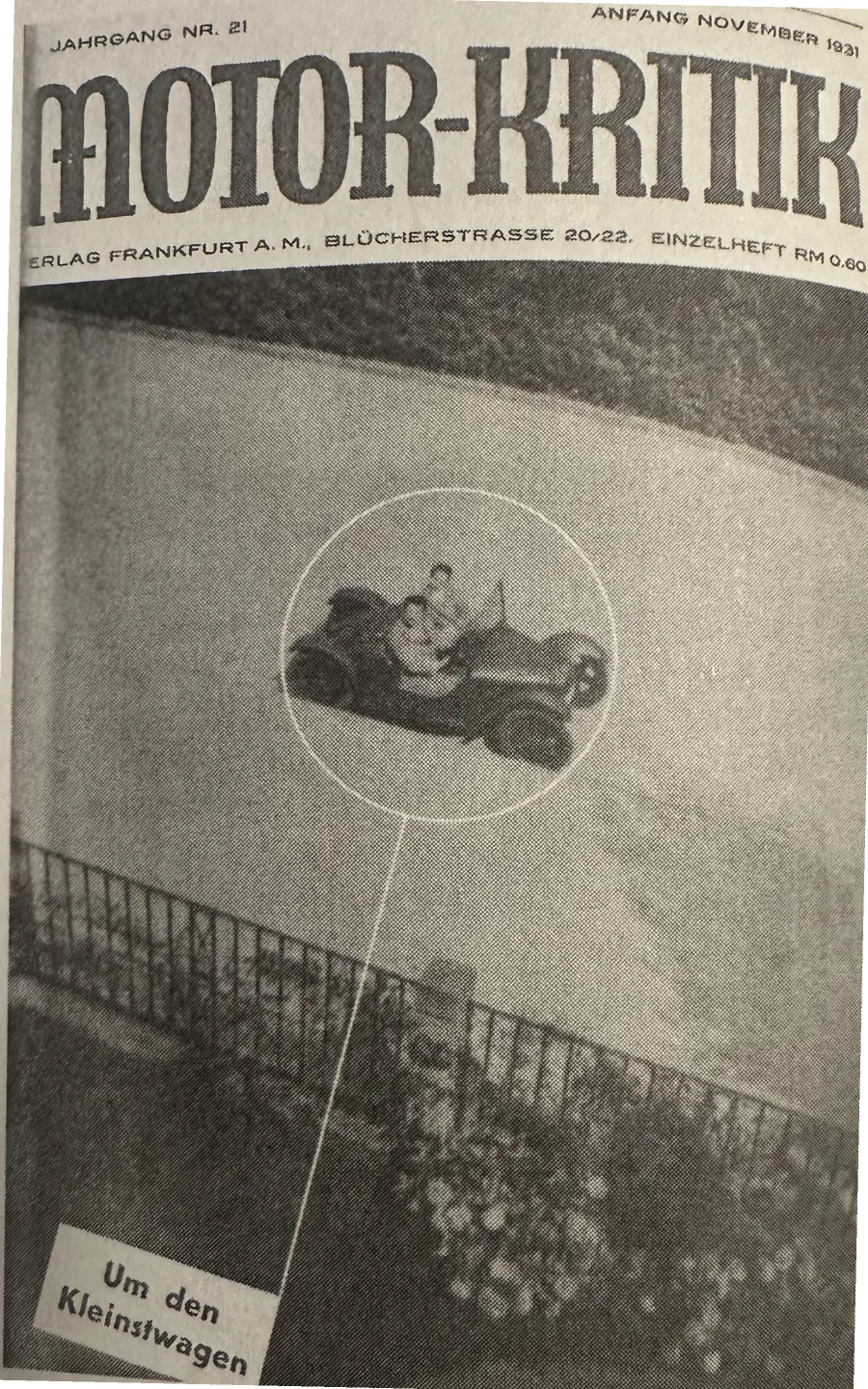
Motor-Kritik no. 21, early November 1931: the Maikäfer, “Um den Kleinstwagen” (reproduced in Schilperoord 2011) Ferdinand PorscheAprilFounds his own design office in Stuttgart with his son-in-law Anton Piëch and the racing driver Adolf Rosenberger.
MayAgrees with Zündapp on a rear-engined small car, his type 12.
DecemberThe type 12 is redrawn with a streamlined body.
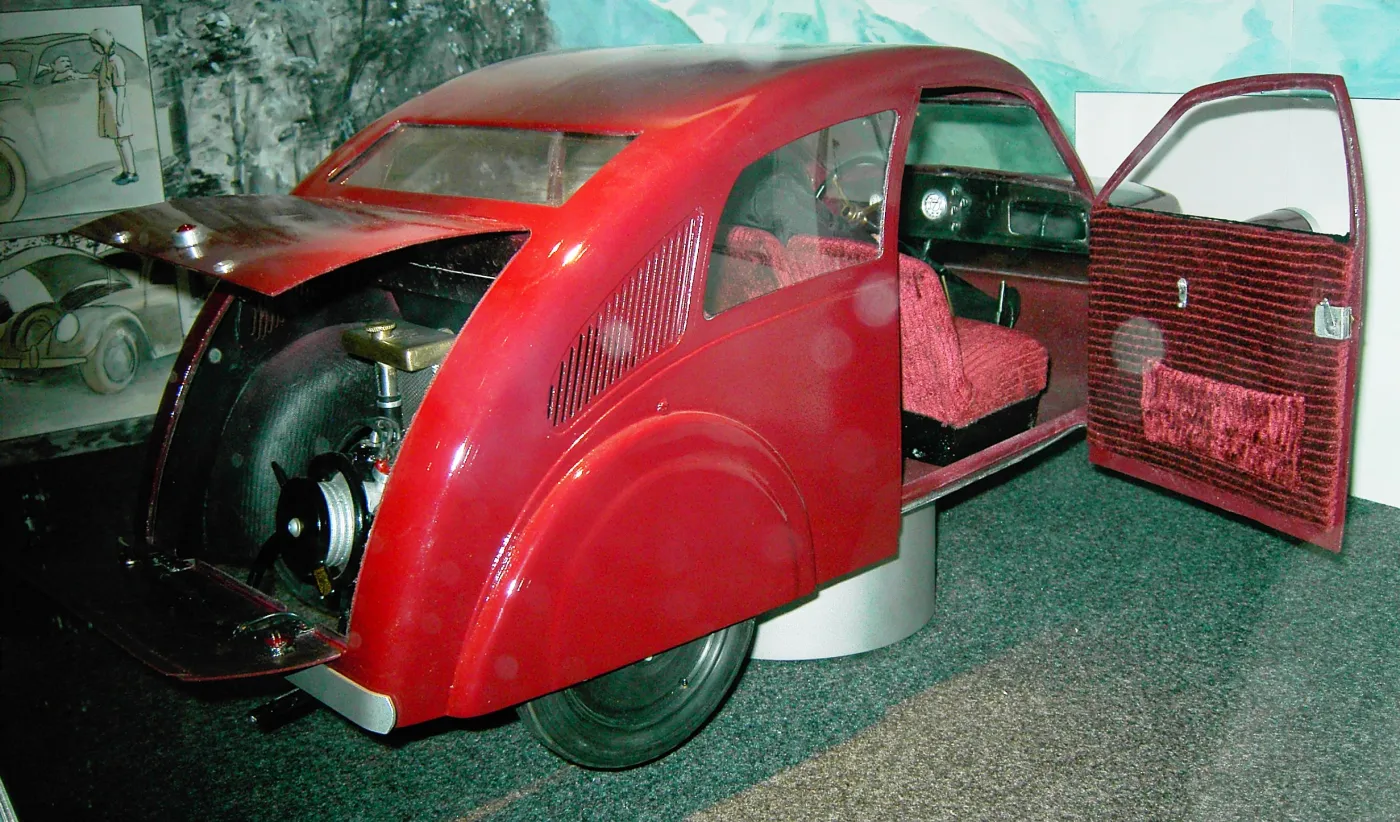
Model of the type 12 for Zündapp, 1931/32 (photo Mb1302, Wikimedia Commons, CC BY-SA 4.0) ContextWhen Porsche turned to small cars, he was known above all as a designer of expensive racing and sports cars; his smaller cars, writes Christof Vieweg, had mostly been flops.
- 1933 Josef GanzFebruary
The Standard Superior, built on his patents, is shown at the Berlin motor show.
MayArrested by the Gestapo.
Ferdinand PorscheMarchMeets Hitler for the first time, about the Auto Union racing car.
ContextOpening the Berlin motor show in February, Hitler calls for motorisation on the broadest level.
- 1934 Josef Ganz
Leaves Germany.
Ferdinand PorscheJanuarySubmits his “Exposé concerning the construction of a German Volkswagen”.
MarchMeets Hitler and Jakob Werlin at the Hotel Kaiserhof in Berlin.
Prototypes for NSU with a rear engine; later that year he is commissioned to design the Volkswagen.
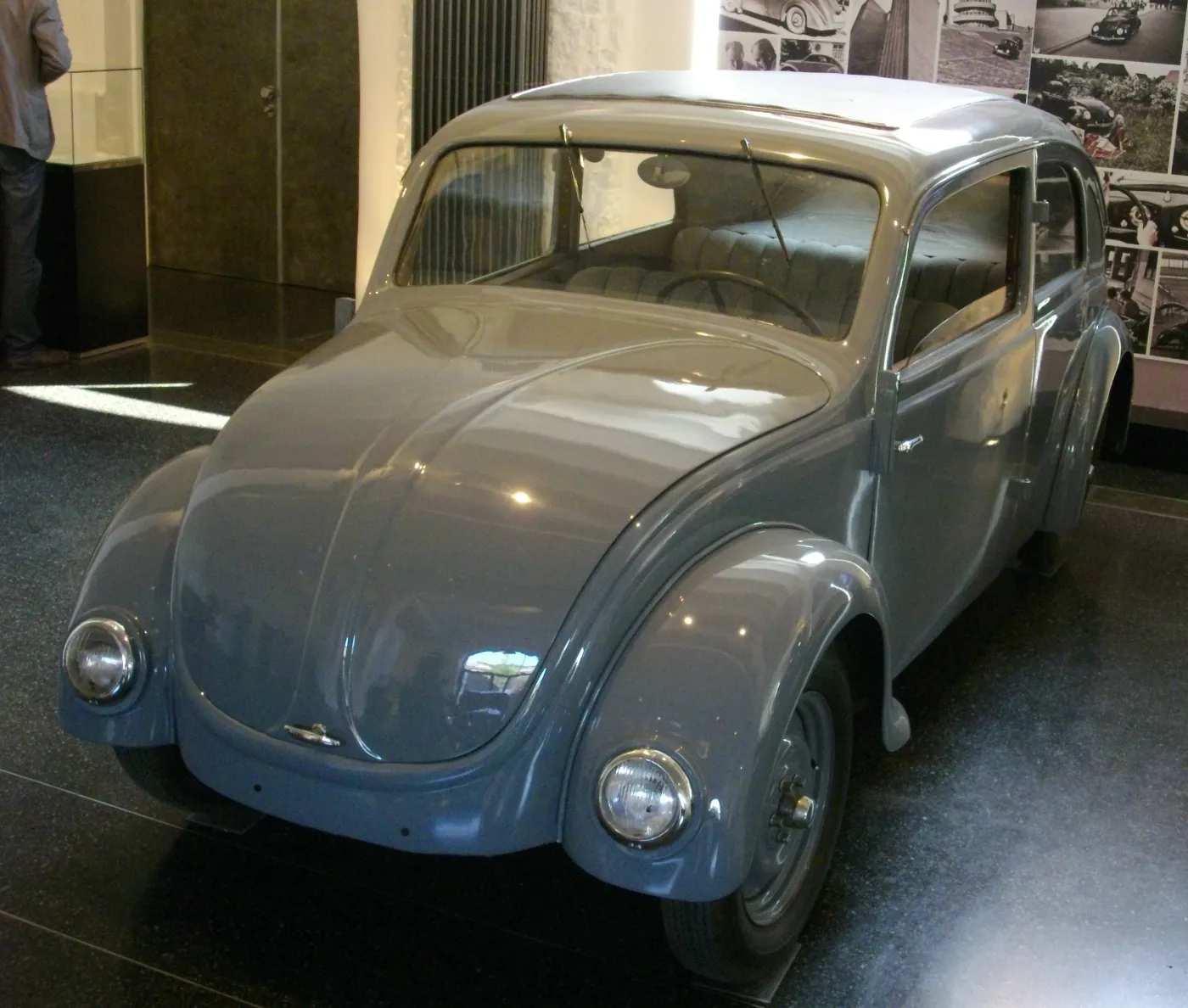
Prototype for NSU, 1934, Prototyp Museum Hamburg (photo Palauenc05, Wikimedia Commons, CC BY-SA 4.0) - 1935 ContextJuly
Adolf Rosenberger, Porsche’s Jewish co-founder, is forced out as a shareholder of the company.
After imprisonment in the Kislau camp he emigrates to the United States in 1938.
- 1936 Ferdinand Porsche
The first Volkswagen test cars are presented; three prototypes follow in October.
- 1938 ContextMay
The foundation stone of the Volkswagen factory is laid.
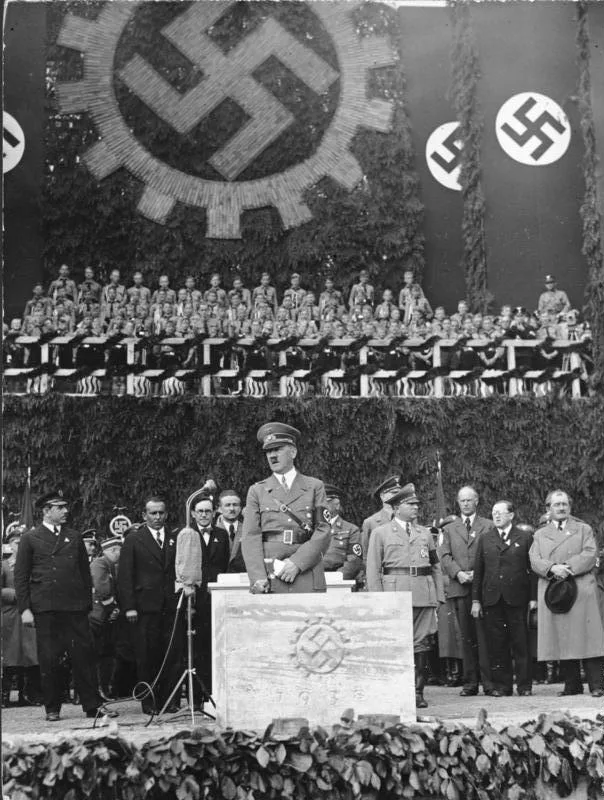
Foundation stone ceremony, 26 May 1938 (Bundesarchiv, Bild 183-H06734, CC BY-SA 3.0 DE) - 1945 Context
Series production of the Volkswagen Beetle begins under British control.
- 1948 Josef Ganz
In a letter to Das Auto he writes that his Maikäfer and his Ardie car, not the Tatra, were decisive for the development.
- 1951 Ferdinand Porsche
Dies on 30 January in Stuttgart.
ContextTwo books credit Porsche alone with the whole Volkswagen concept; Béla Barényi sues their authors.
- 1958 Context
Accepting the Elmer A. Sperry Award for himself and the late Porsche, Volkswagen chief Heinrich Nordhoff names only one other person in his speech: Josef Ganz.
- 1961 Josef Ganz
Helps Volkswagen in the patent case brought by Tatra. Articles by Dieter Grossherr in the Frankfurter Rundschau and the Süddeutsche Zeitung recall him and Adolf Rosenberger, Porsche’s Jewish co-founder.
- 1967 Josef Ganz
Dies in Australia.
ContextAdolf Rosenberger dies in Los Angeles in the same year.
Zündapp, 1930–1931
Around 1930 Fritz Neumeyer, head of the Nuremberg motorcycle maker Zündapp, wanted to build a small car. He discussed it with Josef Ganz, who then built his prototype at the rival firm Ardie instead. In May 1931 Neumeyer turned to Ferdinand Porsche, and together they fixed the main features: two doors, four seats, swing axles with independent suspension and a rear engine. The journalist Christof Vieweg, who studied the Porsche archives, writes that these were "basically not ideas of Neumeyer or Porsche": Neumeyer brought proposals from his earlier experiments, above all from his talks with Ganz. Porsche's office began work on the Zündapp car, its type 12, on 9 September 1931.
The Maikäfer was no secret. In November 1931 Ganz wrote in Motor-Kritik that he had "readily taken many of my colleagues from the trade press and members of the 'competition' for a drive" in it. The cover of that issue shows the car with two men on board; Paul Schilperoord identifies them as Ferry Porsche, the designer's son, and Adolf Rosenberger of the Porsche company, on a test drive in Frankfurt.
In December 1931 the type 12 was suddenly redrawn with a streamlined body, a curved roof and a rounded tail. Vieweg links this to the shape that Ganz had brought into the debate a few months earlier and that Daimler-Benz had just built in its W 17 prototype. Erwin Komenda, who knew the W 17, had moved from Daimler-Benz to Porsche's office in the summer of 1931. See also Josef Ganz and Daimler-Benz.
Ganz later gave his own account. In a letter published in the magazine Das Auto in 1948 he wrote that he had prepared an exposé for Zündapp before Porsche received the commission, and that a sketch of his Ardie car had been made without his knowledge. His conclusion:
„Also nicht der Tatra, sondern der Ganzsche ‚Maikäfer‘ und der Ardie-Versuchswagen sind also für die Entwicklung entscheidend gewesen!“
("So it was not the Tatra but Ganz's 'Maikäfer' and the Ardie test car that were decisive for the development!")
The editors replied that they had not meant to deny Ganz "the intellectual authorship of many achievements of modern car design embodied in the Volkswagen". The details of Ganz's account are his own; no other source confirms them.
1933–1934: the state commission goes to Porsche
When Hitler opened the Berlin motor show in February 1933 and called for motorisation on the broadest level, the established car industry showed little interest in a cheap people's car. According to Paul Schilperoord, only a handful of independent engineers were capable of designing one – among them Ferdinand Porsche, Josef Ganz and Edmund Rumpler. Ganz and Rumpler were soon dropped, not for technical reasons but because both were of Jewish descent. Ganz was arrested by the Gestapo in May 1933 and lost his contracts by the end of the year.
When the press praised the new Auto Union racing car from Porsche's office in early 1934, Motor-Kritik answered dryly:
„Ein unscheinbarer kleiner Maikäfer aus Frankfurt brummte früher vor sich ein Liedchen über Strassenlage und Heckmotoren.“
("An inconspicuous little Maikäfer from Frankfurt used to hum a little song about road holding and rear engines.")
On 17 January 1934 Porsche submitted his "Exposé concerning the construction of a German Volkswagen" to the Reich Ministry of Transport. He did not propose a small car but a full-sized utility car, with a wheelbase of 2.5 metres and a weight of 650 kilograms. In March 1934, during the Berlin motor show, Hitler met Porsche and his adviser Jakob Werlin at the Hotel Kaiserhof and sketched his ideas. Later that year the Reich association of the automobile industry, under pressure from the government, commissioned Porsche to design the car. In 1934 Josef Ganz left Germany.
Adolf Rosenberger
One man links Porsche and Ganz more closely than any other: Adolf Rosenberger. Born in Pforzheim in 1900, he was a successful racing driver for Mercedes in the 1920s and in April 1931 co-founded Porsche's design office with Ferdinand Porsche and Anton Piëch, as its commercial director and with his own money. According to the historian Martin Walter he travelled to Zündapp on 1 September 1931 to negotiate the type 12. Paul Schilperoord writes that in October 1931, after the contract was signed, Rosenberger and Ferry Porsche came to Frankfurt to test-drive Ganz's Maikäfer.
Rosenberger's fate ran parallel to Ganz's. Like Ganz he was Jewish, and like Ganz he lost his place after 1933. A study by the historian Joachim Scholtyseck, published in 2025, describes how he left the management in early 1933, was forced out as a shareholder in July 1935 and was briefly imprisoned in the Kislau camp. He emigrated to the United States in 1938 and lived there as Alan A. Robert. Both men were written out of the history of the Volkswagen, both were recalled by Dieter Grossherr in 1961 – and both died in exile in 1967.
After the war
Porsche died in 1951. In the same year two books credited him alone with the whole Volkswagen concept. Béla Barényi sued their authors, and in 1954 the patent chamber in Mannheim found that Barényi had drawn the decisive features of the engine layout before Porsche (see Josef Ganz and Béla Barényi). Kurt Hopfinger's history of the Volkswagen, based on conversations with Porsche and with Volkswagen chief Heinrich Nordhoff, did not mention Ganz at all.
Nordhoff himself knew Ganz's role. When he accepted the Elmer A. Sperry Award in New York in November 1958 for himself and the late Porsche, he named only one other person in his speech: Josef Ganz, whose Motor-Kritik had spurred young engineers to take up the challenge. In October 1961, when Volkswagen marked 25 years since its first prototypes, the journalist Dieter Grossherr wrote in the Frankfurter Rundschau and the Süddeutsche Zeitung about Ganz and Adolf Rosenberger, the Jewish co-founder and financier of Porsche's company, both forgotten in the history of the Volkswagen.
From 1961 Ganz helped Volkswagen defend itself against Tatra (see Josef Ganz and Tatra). Nordhoff supported him personally, but made clear that for the company all its designs went back to "the work of Professor Porsche and his staff". According to Schilperoord, Ganz still had great respect for Porsche, but was determined to make his own role known.
What the sources show
None of the sources shows that Porsche copied Ganz's designs. They do show that the features of the later Beetle – rear engine, swing axles, central tube, streamlined body – were part of a public debate that Ganz led in Motor-Kritik before Porsche took up the subject; that Zündapp's brief of 1931 drew on Neumeyer's talks with Ganz; and that Ganz was no longer in Germany when the state project began. From 1933, as the automotive historian Michael Graf Wolff Metternich wrote, "the wind of state authority and of the antisemitism of the Third Reich" blew ever harder against him; he emigrated in 1934, and in 1938 he was stripped of his German citizenship.
Sources
- Christof Vieweg: Die Akte Volkswagen. GeraMond, Munich 2014, pp. 31, 60, 82–83.
- Martin Walter: "Der Pforzheimer Adolf Rosenberger – ein deutsch-jüdisches Schicksal", 2006.
- Joachim Scholtyseck: biography of Adolf Rosenberger, 2025; summarised in autohaus.de.
- Paul Schilperoord: "Reader feedback: Josef Ganz and the people's car". SAH Journal no. 315, March/April 2022.
- Paul Schilperoord: Die wahre Geschichte des VW-Käfers. Huber, Frauenfeld 2011, pp. 192, 196, 200–201, 215–219, 282–289 (English edition: The Extraordinary Life of Josef Ganz).
- Josef Ganz: "Eine Seite ‚Maikäfer‘". Motor-Kritik no. 21, early November 1931, pp. 472–473.
- Paul Schilperoord: The Extraordinary Life of Josef Ganz. René van Praag Publishers, 2011 (photo caption to the Motor-Kritik cover of November 1931).
- Josef Ganz: "Zur Entstehung der Volkswagen-Konstruktion" (letter to the editor). Das Auto, 1948, no. 10, p. 20.
- Dieter Grossherr: "Das Wunder auf Bestellung". Frankfurter Rundschau, 28 October 1961, p. 48; "Der Volkswagen feiert seinen 25. Geburtstag – Zwei heute fast vergessene Männer standen Pate". Süddeutsche Zeitung, 20 October 1961 (cited in Schilperoord, p. 285).
- Michael Graf Wolff Metternich: "Der streitbare Geist Josef Ganz". Automobil Revue no. 41, 4 October 1990, p. 69, and no. 42, 11 October 1990, pp. 65, 67.
- Harry Niemann: Béla Barényi – Nestor der passiven Sicherheit. Mercedes-Benz AG, Stuttgart 1994, pp. 93–106.